


What is AI Glass? 7 Things You Should Know
AI Glass is a wearable device that looks like ordinary eyeglasses but has built-in artificial intelligence. It can see what you see, hear what you hear, and provide real-time information, translation, navigation, or visual assistance through a small display or voice feedback. In simple terms, it turns your glasses into a smart, hands-free AI assistant.
What is AI glass? Now let’s dive deeper into what makes AI Glass so interesting.
1. How does AI Glass work?
AI Glass typically contains a tiny camera, microphones, speakers, a processor, and sometimes a small display (like a waveguide or micro-OLED). The camera captures your field of view, while the microphones pick up your voice and surrounding sounds. The processor runs lightweight AI models on the device or sends data to the cloud for more complex tasks. For example, it can recognize faces, read text aloud, translate signs, or give you step-by-step directions.
2. What can you actually do with AI Glass?
Here are some everyday uses:
- Real‑time translation – See subtitles of a foreign conversation right on the lens.
- Navigation – Arrows appear in your vision as you walk or cycle, without looking at a phone.
- Meeting assistant – Record and transcribe meetings, summarize action points.
- Visual help for the blind – Identify obstacles, read signs, or describe scenes.
- Hands‑free checklist – While cooking or repairing, ask “What’s the next step?”
- Facial recognition – If allowed, remind you of a person’s name and last interaction.
3. AI Glass vs. regular smart glasses
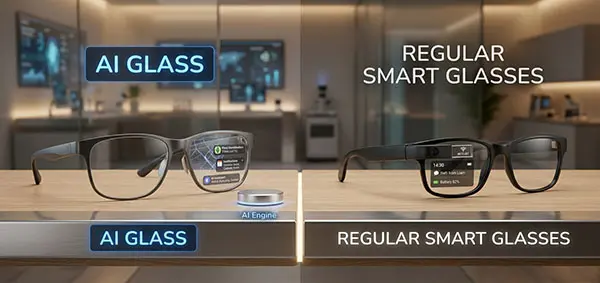
Many people confuse AI Glass with older “smart glasses” that only showed notifications. The key difference is on‑device AI. The table below highlights the main differences.
| Feature | Regular Smart Glasses | AI Glass |
| Core function | Display notifications, take photos | Real‑time AI assistance, scene understanding |
| AI processing | Minimal (mostly app‑based) | On‑device or edge AI for instant response |
| Voice interaction | Basic commands | Conversational, context‑aware |
| Example tasks | Show weather, answer calls | Translate speech, identify objects, give walking directions |
| Internet dependency | Often required | Many tasks work offline |
4. Benefits of AI Glass (Why you might want one)
- Hands‑free convenience – No need to pull out your phone.
- Instant answers – The AI sees your world, so you don’t have to describe it.
- Accessibility – Game‑changing for people with vision or hearing challenges.
- Privacy control – Newer models have a “recording” LED that turns on when the camera is active.
5. Current challenges and concerns
AI Glass is still new, so there are a few hurdles:
- Battery life – Constant AI processing drains power (most last 4‑6 hours).
- Privacy worries – Cameras always on? What about people around you?
- Limited field of view – The display covers only a small part of the lens.
- Cost – High‑end models can be over $1,000.
6. Who is making AI Glass today?
Several tech companies have entered this space. Notable examples include:
- Meta (Ray‑Ban Stories with AI upgrades).
- XREAL (Air series with AI companion).
- Solos (AirGo Vision – uses GPT‑4o for real‑time queries).
- Brilliant Labs (Frame – open source AI glasses).
7. Will AI Glass replace smartphones?
Not anytime soon. Think of AI Glass as a companion device – great for quick, hands‑free tasks, but not for deep work or media consumption. In the future, as battery and display tech improve, it might become as common as smartwatches are today.

7 Frequently Asked Questions (FAQ)
Q1: Are AI Glass always recording ?
No. Most models require an action – like pressing a button or saying a wake word – to start the camera. A visible light usually shows when recording.
Q2: Can AI Glass work without internet ?
Yes, basic features like object recognition and voice commands work offline. Advanced tasks (live translation, cloud search) need an internet connection.
Q3: Do I need a prescription version?
Many brands offer prescription lenses as an add‑on. You can also wear AI Glass over your regular glasses (though it may feel bulky).
Q4: How much does a good AI Glass cost?
Entry‑level starts around $200, decent mid‑range is $400–$600, and premium models (with full‑color displays) go above $1,000.
Q5: Is my privacy at risk?
It depends on the brand. Look for models with local‑only AI processing, physical camera shutters, or clear LED indicators. Avoid unknown cheap brands from online marketplaces.
Q6: Can AI Glass replace a smartwatch?
They complement each other. A smartwatch is better for fitness tracking and quick glances. AI Glass excels at visual assistance and hands‑free interaction.
Q7: When will AI Glass become mainstream?
Most analysts predict 2027–2029 as the turning point – when battery life reaches all day, displays become truly unobtrusive, and prices drop under $300.