
How Much Do AI Glasses Cost in 2026? A Complete Price Guide by Type
AI glasses prices in 2026 range from $13 to $3,500+ depending on type, features, and brand. The spread is enormous-and understanding why is the difference between a smart purchase and an expensive mistake. This guide breaks down the real cost of every major AI glasses category, explains what drives the price gap, and shows you exactly what you get at each price point.
Whether you’re a business sourcing 500 units for your field team, a retailer building a wearable tech catalog, or a consumer trying to figure out if AI glasses are actually worth it-this is the most complete AI glasses price breakdown you’ll find in 2026.
AI Glasses Price Overview: What to Expect at Every Level
Before diving into specifics, here’s the big picture. AI glasses span five distinct categories, and each category has its own price logic, hardware requirements, and value proposition.
| Category | Price Range (Retail) | Wholesale MOQ Price |
|---|---|---|
| AI Audio Glasses | $30-$80 | From $13.75/unit |
| AI Camera Glasses | $80-$200 | From $49.85/unit |
| AI Translation Glasses | $60-$150 | From $25/unit |
| AI Live Streaming Glasses | $120-$250 | From $75.95/unit |
| AI+AR Display Glasses | $350-$700 | From $285/unit |
The gap between wholesale and retail isn’t just markup-it reflects distribution costs, warranty support, app ecosystem development, and brand positioning. For B2B buyers, the wholesale numbers matter most. Let’s dig into each category in detail.
AI Audio Glasses Price: The Most Affordable AI Wearable
AI audio glasses are the entry point into AI wearables-and they’re more capable than their price suggests. At their core, they combine open-ear speakers or bone-conduction audio with AI voice assistant access, hands-free calling, and increasingly, on-device AI for language processing and ambient audio enhancement.
In 2026, retail prices for AI audio glasses typically fall between $30 and $80. Wholesale pricing for bulk B2B orders starts as low as $13.75 per unit-making them one of the most cost-effective smart wearables available at scale.
What Affects AI Audio Glasses Pricing?
Three hardware factors drive most of the price variation in this category:
Speaker technology: Open-ear directional speakers cost more than side-firing drivers but deliver better sound quality and lower audio leakage. Premium audio glasses use custom-tuned drivers from Qualcomm or similar suppliers, while budget models use standard Bluetooth audio chips.
AI chip integration: Entry-level AI audio glasses rely entirely on a connected smartphone for AI processing. Mid-range and premium models include an edge AI chip that handles wake-word detection, noise cancellation, and basic NLP on-device-improving response speed and reducing battery drain on your phone.
Frame design and materials: TR90 frames (lightweight, flexible) cost more than standard plastic. Titanium-reinforced hinges add durability for professional use. OEM buyers who want prescription-compatible frames will pay a premium for adjustable nose pads and wider lens sizing.
| Spec Tier | Wholesale Price | Key Features |
|---|---|---|
| Entry | $13-$20 | BT 5.3, 8hr battery, basic voice commands |
| Mid-range | $25-$40 | Edge AI chip, noise cancel, companion app |
| Premium | $45-$65 | Spatial audio, IPX5, custom AI wake word |
For most B2B buyers-retailers, corporate wellness programs, warehouse operations, or language learning platforms-the entry-to-mid tier delivers excellent value. You’re equipping a team of 50 for what a single enterprise AR headset costs.
AI Camera Glasses Price: Vision-Enabled AI at Mid-Range Costs
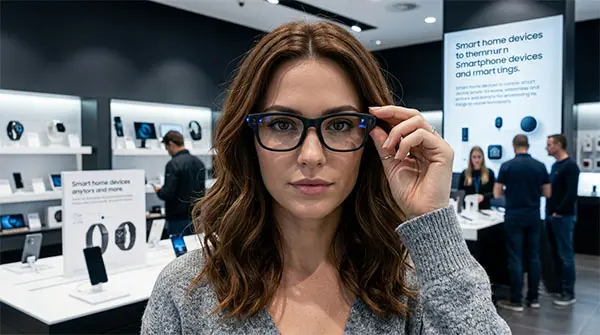
AI camera glasses add a first-person camera to the audio base, enabling photo capture, video recording, live streaming, and visual AI features like object recognition and scene description. This is the category that Meta’s Ray-Ban made famous-but the price spectrum is much wider than most people realize.
Retail prices range from $80 to $200. Wholesale pricing starts around $49.85 per unit for OEM/ODM orders, scaling down with volume.
Camera Resolution and AI Features Drive the Price Gap
The biggest cost variable in AI camera glasses is image sensor quality and the accompanying AI processing pipeline.
Low-end models use a 5MP fixed-focus sensor with basic photo/video capture. There’s no real-time AI-you take a photo and analyze it later via an app.
Mid-range models feature 12-16MP sensors with electronic image stabilization and a local AI co-processor. These can do real-time object tagging, QR code reading, and basic OCR. Battery life typically runs 3-5 hours with active camera use.
Premium models incorporate 4K video capability, AI-powered live scene description (reading text, identifying faces with consent flags, describing surroundings for visually impaired users), and 5G/Wi-Fi direct upload. These models often include dedicated NPU (Neural Processing Unit) chips and cost significantly more to produce.
| Model Tier | Camera Spec | Wholesale Price |
|---|---|---|
| Entry camera | 5MP, fixed focus | $49-$60 |
| Mid camera | 12MP, EIS, AI tagging | $62-$90 |
| Premium camera | 16-32MP, 4K, NPU | $95-$150 |
For content creators, real estate agents, field technicians, and security-aware enterprise teams, AI camera glasses provide a hands-free visual capture capability that no other wearable matches at this price point. The critical consideration for B2B buyers: ensure your deployment region’s privacy laws allow camera-equipped eyewear in the intended use environment. Review our guide on AI glasses legality before purchasing.

AI Translation Glasses Price: Specialized Value
AI translation glasses are purpose-built for real-time multilingual communication. They combine a microphone array with AI-powered speech recognition and translation-delivering translated audio to the wearer through bone conduction or open-ear speakers while simultaneously (in some models) displaying a text translation on a companion app or a small mono display.
Retail pricing typically runs $60 to $150, with wholesale pricing starting around $25 per unit for OEM buyers.
What Justifies the Price of AI Translation Glasses?
Translation glasses require more sophisticated AI integration than basic audio glasses. The BOM (bill of materials) is similar, but the software licensing and cloud API costs are higher.
Real-time translation at a useful quality level requires either: (a) a reliable internet connection to a cloud translation API like Google Cloud Translation or DeepL, or (b) an on-device translation model stored in local memory-which requires larger flash storage and a more capable processor, both of which cost more.
Support for more language pairs also increases licensing costs. Entry models typically support 10-15 languages; premium models support 50-100+ languages with dialect recognition. For businesses with global footprints-trade fair teams, multilingual customer service, international sales-the premium language support is worth the incremental cost.
A travel accessories retailer in Amsterdam who began stocking AI translation glasses at the $25 wholesale price point saw a 40% reorder rate within three months. “Our customers use them on vacation and immediately buy a second pair as gifts,” the buyer reported. The product effectively sells itself once demonstrated.
AI Live Streaming Glasses Price: Content Creator Tools at a Premium
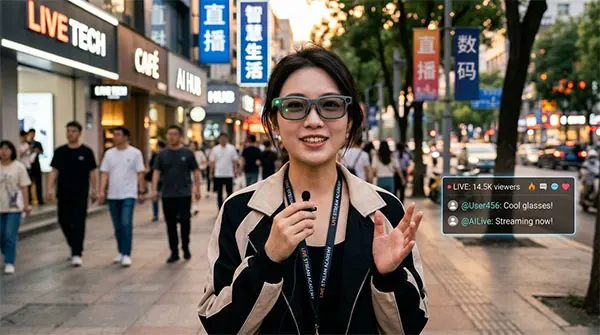
AI live streaming glasses are the highest-spec camera glasses variant, optimized specifically for real-time video broadcast to social platforms, enterprise video systems, or custom streaming servers. They include higher-resolution sensors, improved stabilization, better compression chips, and in some cases built-in 5G or Wi-Fi 6 connectivity.
Retail pricing runs $120 to $250. Wholesale starts around $75.95 per unit.
Why Live Streaming Glasses Cost More
Continuous HD video streaming is one of the most demanding workloads a wearable can handle. The hardware required to do it well-and keep battery life above two hours-adds meaningful cost:
Video compression hardware: Quality streaming at 1080p/30fps requires hardware H.264/H.265 encoding (not software). A dedicated media encoder chip adds $8-$15 to the BOM but reduces CPU load and battery drain dramatically.
Thermal management: Continuous streaming generates heat in a form factor with almost no airflow. Premium live streaming glasses include graphite heat spreaders or micro-perforated frame sections to prevent thermal throttling.
Wireless connectivity: A 5G modem in a glasses frame requires RF engineering, antenna placement work, and regulatory certification across multiple markets-all of which add to development cost and price.
For brand content teams, police body-cam alternatives, real estate walkthrough specialists, or remote expert systems, the live streaming capability justifies the premium. At under $80 wholesale, a team of 10 field operators can broadcast simultaneously for the cost of a single mid-range mirrorless camera.
AI+AR Display Glasses Price: Premium Tier
AI+AR display glasses are the most sophisticated category. They combine everything from the previous categories-AI voice assistant, camera, translation capability-with an optical waveguide or birdbath display that overlays digital content directly in your field of vision. This is where AI glasses cross into augmented reality territory.
Retail prices run from $350 to $700 for consumer/prosumer models, with enterprise variants reaching $1,500 to $3,500+. OEM/ODM wholesale pricing starts around $285 per unit at volume.
The Hardware That Makes AI+AR Expensive
The price jump from AI audio/camera glasses to AI+AR display glasses isn’t just incremental-it reflects fundamentally different hardware architecture.
Waveguide optics: The optical element that projects images into your field of view is the most expensive single component in an AR display glasses. High-quality waveguides are manufactured using nanoimprint lithography-a precision process with low yields that drives unit costs significantly higher than standard optical lenses.
Display engine: The micro-OLED or micro-LED display panel that feeds the waveguide must achieve extreme brightness (typically 1,000-5,000 nits) in a tiny form factor to be visible in daylight. These panels are more expensive per square millimeter than any other display technology in consumer electronics.
Spatial tracking and processors: AR glasses need to track head movement, map the environment, and maintain display registration with real-world objects in real time. This requires IMU sensors, possibly depth cameras, and a capable SoC (system-on-chip) with dedicated spatial processing.
| AR Tier | Display Type | Wholesale Price |
|---|---|---|
| Entry AR | Mono waveguide, basic HUD | $285-$350 |
| Prosumer AR | Binocular waveguide, full color | $350-$525 |
| Enterprise AR | High-brightness, 6DoF tracking | $600-$1,500 |
For enterprise deployments-industrial training, surgical guidance, architecture visualization, or complex assembly workflows-the ROI can be compelling. Studies consistently show AR-guided workflows reducing training time by 30-50% and field service errors by 25%. At those productivity gains, even $1,000 per headset pays back quickly.
Factors That Affect AI Glasses Price Beyond Hardware
Hardware is only part of the price equation. Several non-hardware factors significantly influence what you’ll pay-and what you’re actually getting.
Brand Premium
A pair of AI audio glasses from Meta (Ray-Ban Meta, $299 retail) and a comparable pair of AI audio glasses from an OEM manufacturer ($30-$50 retail) use similar hardware at the component level. What you’re paying for with the premium brand is: the app ecosystem, the AI model quality (Meta AI vs. a white-label voice assistant), the distribution network and warranty support, and the social acceptability of wearing them in public. These are real value differences-but they’re not hardware costs.
For B2B buyers sourcing at volume, OEM/ODM pricing gives you the hardware at near-cost and lets you build your own app experience and brand positioning around it.
Software and AI Subscription Costs
Hardware is a one-time purchase; software can be recurring. Some AI glasses come with bundled AI features that require a monthly subscription after a free trial period. Translation glasses that use cloud translation APIs may charge per-minute or per-character. Live streaming glasses may include streaming server access that costs extra.
Before finalizing a purchase decision, always calculate total cost of ownership (TCO) over 24 months, not just the upfront hardware cost. A $50 glasses unit with a $10/month AI subscription costs more than a $120 glasses unit with no subscription over two years.
Certification and Compliance Costs
For B2B buyers deploying in regulated industries or multiple markets, certification requirements add to the effective cost. FCC (US), CE (EU), UKCA (UK), and SRRC (China) certifications all require testing and documentation. Glasses with cameras face additional privacy-related compliance requirements in GDPR jurisdictions. Ask your OEM supplier which certifications are included and what additional compliance documentation is available.
Warranty and After-Sales Support
Consumer-grade AI glasses typically come with a 1-year limited warranty. Enterprise and industrial models often include 2-3 year warranties with advance replacement. OEM partnerships can include custom warranty terms. For large B2B deployments, factor in the per-unit warranty cost difference-a $15/unit warranty premium for enterprise coverage is often worth it when you’re deploying 1,000+ units.
AI Glasses Price Comparison by Use Case
The best AI glasses price is the one that matches your actual use case. Here’s how different deployment scenarios map to the right product tier.
| Use Case | Recommended Type | Budget per Unit |
|---|---|---|
| Warehouse voice picking | AI Audio Glasses | $15-$30 |
| Multilingual sales team | AI Translation Glasses | $25-$50 |
| Real estate / property tours | AI Camera Glasses | $50-$90 |
| Social media content creation | AI Live Streaming Glasses | $76-$120 |
| Industrial field service | AI+AR Display Glasses | $285-$525 |
Notice that the majority of high-volume B2B use cases-logistics, sales, customer service, education-fall in the $15 to $90 per unit range. Full AI+AR capability is genuinely necessary for a narrower set of industrial applications. Don’t pay for spatial computing if you just need hands-free voice intelligence.
How AI Glasses Prices Have Changed Since 2024
The AI glasses market has moved quickly. Understanding the price trajectory helps set realistic expectations for what’s coming.
AI audio glasses: Down 20-30% since 2024, driven by BT chip commoditization and maturing manufacturing for TR90 frames in Shenzhen. The $13-$15 wholesale floor will likely hold through 2026 before dropping further as volume scales.
AI camera glasses: Roughly flat in the entry tier, with premium features (higher resolution, better EIS, on-device AI) now available at price points that required enterprise budgets two years ago. The $50 wholesale camera glasses today are meaningfully better than the $80 equivalents from 2024.
AI+AR display glasses: Down 15-25% in the prosumer tier as waveguide manufacturing yields improve and competition from Chinese manufacturers increases. The sub-$300 waveguide display unit-which didn’t exist two years ago-is now a real product category.
Enterprise AR headsets: Prices have been relatively stable at the high end ($1,500-$3,500), but the feature-per-dollar value has improved significantly. The compute power and display quality you get at $1,500 today required $5,000+ in 2022.
Where to Buy AI Glasses: Retail vs. OEM vs. Wholesale
Where you buy significantly affects what you pay-and what you get.
Retail purchase (Amazon, Best Buy, brand direct): Full retail price, full warranty, easy returns. Right choice for small quantities (1-10 units) or when you need the specific brand experience.
Wholesale distributor: 30-50% below retail on branded goods. Right choice for resellers buying 50-500 units of established brands.
OEM/ODM manufacturer (e.g., aisensewear): Closest to manufacturing cost-typically 60-80% below retail. You’re buying the hardware platform and building or licensing the software layer. Right choice for brands, enterprises, and B2B resellers ordering 100+ units who want their own branding and can manage app integration. Browse AI glasses options to compare product lines and request volume pricing.
For most businesses reading this guide, OEM/ODM pricing is the path that makes large-scale AI glasses deployment economically viable. The difference between $299 retail and $30 wholesale for functionally similar hardware-multiplied by 500 units-is $134,500 in saved procurement cost.
Is the Price Worth It? How to Calculate AI Glasses ROI
The right question isn’t “how much do AI glasses cost?” It’s “what return does this investment generate?”
Here’s a simple framework for B2B ROI calculation:
Step 1 – Identify the problem being solved. Real-time translation for a 20-person multilingual sales team? Hands-free documentation for field technicians? Hands-free order picking in a warehouse?
Step 2 – Estimate time saved per employee per day. If AI translation glasses save a sales team 30 minutes of post-meeting translation and follow-up work per day, that’s 2.5 hours per week per person.
Step 3 – Value the time. At an average fully-loaded labor cost of $35/hour, 2.5 hours/week × $35 = $87.50/week per person in recovered productivity. Over 12 months, that’s $4,550 in value per employee.
Step 4 – Compare to hardware cost. AI translation glasses at $25 wholesale + $10/month software subscription = $145 total cost over 12 months. ROI is 31×. Even at $150 retail, the math strongly supports the investment.
The ROI calculation shifts for more expensive categories like AI+AR display glasses-the productivity gains need to be larger to justify the higher hardware cost. But for industrial environments where AR-guided procedures prevent a single $10,000 error per month, a $500 headset is an obvious purchase.

FAQs About AI Glasses Costs
1.How much do AI glasses cost on average in 2026?
The average cost of AI glasses in 2026 ranges from $30 to $700 retail depending on type. AI audio glasses average $30-$80; AI camera glasses average $80-$200; AI+AR display glasses average $350-$700. Wholesale and OEM pricing is significantly lower, starting at $13.75 per unit for AI audio glasses from manufacturers like aisensewear.
2.Why are some AI glasses so cheap and others so expensive?
The price gap reflects fundamentally different hardware. Cheap AI glasses ($30-$80) are basically premium Bluetooth audio hardware with AI voice assistant access via your phone. Expensive AI glasses ($500-$3,500) include waveguide optical displays, spatial tracking sensors, and dedicated AI processors-each of which involves precision manufacturing at high per-unit cost. The use case requirements differ completely.
3.Are cheap AI glasses worth buying?
Yes, for the right use cases. AI audio glasses at $30-$80 retail deliver genuine value for hands-free calling, music, voice AI access, and real-time language assistance. They’re not cheap in quality-they’re affordable because the hardware (Bluetooth chip + open-ear speakers + frame) doesn’t require expensive optical components. For B2B buyers sourcing at wholesale ($13-$25/unit), they’re one of the best ROI purchases in the wearable tech category.
4.What is the cheapest AI glasses option for B2B buying?
The cheapest functional AI glasses for B2B purchase are AI audio glasses from OEM manufacturers in Shenzhen, starting at approximately $13.75 per unit at MOQ (minimum order quantity). These include Bluetooth 5.3 audio, 8+ hours of battery life, and AI voice assistant access. They’re suitable for warehouse operations, customer service teams, logistics, and any workflow where hands-free voice intelligence is the primary requirement.
5.Do AI glasses have subscription fees?
Some do, some don’t-it depends on the brand and AI features. AI glasses that use cloud translation APIs (Google, DeepL, Microsoft) often charge per-minute or monthly. AI glasses that use your phone’s built-in voice assistant (Siri, Google Assistant) typically have no additional fees. OEM/ODM AI glasses can be configured with your choice of AI backend, allowing you to control subscription costs at the platform level.
6.How much cheaper are AI glasses from Chinese manufacturers vs. brands like Meta?
OEM AI glasses from Shenzhen manufacturers typically cost 70-85% less than equivalent-feature branded products at retail. A $299 Ray-Ban Meta (AI audio + camera) compares to $50-$75 wholesale OEM hardware with similar core specs. The branded product includes Meta AI integration, the Ray-Ban design license, and Apple/Google ecosystem connectivity-which have real value. For B2B buyers who can manage their own software layer, OEM pricing offers significant procurement savings.
7.Will AI glasses get cheaper in 2027 and beyond?
Yes, across all categories. AI audio glasses are already approaching commodity pricing ($13-$15 wholesale) and should see modest further declines. Camera and translation glasses will follow as component costs normalize. The biggest price drops are expected in AI+AR display glasses as waveguide manufacturing scales and competition increases-the sub-$200 retail AR glasses that exists mainly in prototype form today should become mainstream by 2027-2028. Enterprise AR headsets will remain premium but offer significantly better value per dollar.