

AI Glasses vs Smart Glasses vs AR Glasses: 9 Key Differences That Matter
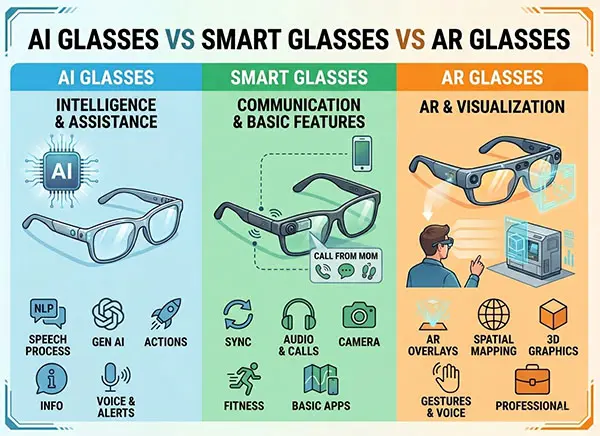
AI glasses are wearable devices that use artificial intelligence to process voice, visual, and sensor data in real time, often without a display. Smart glasses are internet-connected eyewear that add basic digital features like audio playback, notifications, or camera capture to a glasses form factor. AR glasses overlay digital information onto your real-world view through optical displays like waveguides. Understanding AI glasses vs smart glasses vs AR glasses is critical because these three categories look similar but serve fundamentally different purposes and choosing the wrong one can cost you thousands in misplaced investment.
Last March, a mid-size eyewear distributor in Berlin ordered 2,000 units of what their supplier called “smart glasses.” They expected AI-powered translation and voice assistant features. What arrived were basic Bluetooth audio glasses with no AI processing at all. The shipment sat in a warehouse for six months. That costly mistake started with one simple problem: nobody on the team understood the difference between these categories.
If you’ve ever felt confused by the blur of marketing buzzwords around smart eyewear, you’re not alone. The lines between AI glasses, smart glasses, and AR glasses get deliberately smudged by brands eager to claim the latest tech label. This guide cuts through that noise. You’ll get a clear, side-by-side breakdown of all 9 key differences from core technology and processing power to price and privacy so you can make the right call for your business or personal use.
1. Core Technology: AI Processing vs Connectivity vs Visual Overlay
The single most important distinction between these three types of eyewear is what they do with technology and it comes down to three fundamentally different approaches.
AI glasses are built around artificial intelligence as their primary function. They use onboard AI chips or cloud-connected AI models to process what you say, what you see, and what’s happening around you. The emphasis is on intelligence: real-time language translation, voice-activated assistants, object recognition, and contextual awareness. Many AI glasses don’t even have a display because the AI delivers value through audio, haptics, or connected apps instead.
Smart glasses focus on connectivity. They extend your smartphone’s capabilities to your face,streaming music, taking calls, showing notifications, or capturing photos and video. Think of them as a Bluetooth headset and a camera rolled into a pair of frames. The intelligence lives on your phone; the glasses are essentially a peripheral.
AR glasses prioritize visual overlay. Their defining feature is an optical display system (usually waveguide-based) that projects digital content onto your field of vision. Whether it’s navigation arrows on the street, a floating video call window, or step-by-step repair instructions overlaid on machinery, AR glasses are about seeing digital information in your real world.
Q: Can one pair of glasses be all three? A: Yes,some premium devices combine AI, smart features, and AR displays, but most products prioritize one category and add elements of the others as secondary features.
2. Display and Visual Output: No Screen vs Notifications vs Full Overlay
How each type of glasses delivers information to you is where the physical differences become impossible to ignore.
AI glasses often have no visual display at all. They communicate primarily through audio,bone-conduction speakers, open-ear drivers, or connected earbuds. Some use a small LED indicator light to show status, but the main information channel is your ears. This isn’t a limitation; it’s a design choice that keeps weight down and battery life up. As we explore in our guide on what AI glass can actually do without a screen, screenless AI glasses can still translate conversations, identify objects, and answer questions,all through voice.
Smart glasses may include a small heads-up display (HUD), a single-eye micro-display, or simple LED notifications. The Ray-Ban Meta, for example, has no display but uses a small LED light to indicate recording. Other smart glasses show basic text alerts,caller ID, message previews, or step counts. The display is secondary to the connectivity features.
AR glasses live and die by their display quality. They use optical waveguides, micro-OLED panels, or birdbath optics to project images that appear to float in your real-world view. A typical AR glasses display might show a 40,50° field of view at 720p to 1080p resolution. The entire hardware architecture,optics, processors, batteries,is built around making that display work well.
When Sarah Chen, a field service manager at an industrial equipment company in Houston, first tried AR glasses for equipment repair, she was stunned. “The schematic literally appeared on top of the machine I was fixing,” she recalls. “I could see which bolts to loosen without looking at a tablet.” That visual overlay is something no AI or smart glasses can replicate.
3. Processing Power and Architecture: Edge AI vs Phone-Dependent vs Dual Processing
What happens inside the frames determines what the glasses can actually do and how much they cost to build.
AI glasses increasingly feature dedicated AI processing chips. Meta’s Ray-Ban Meta glasses, for instance, use a custom AI architecture that combines on-device processing for fast tasks (wake word detection, basic gesture recognition) with cloud-based AI for heavier workloads (visual question answering, complex translations). This edge-plus-cloud approach minimizes latency while preserving battery life. Entry-level AI glasses may rely entirely on a connected smartphone for processing, but the trend is moving toward on-device AI chips that can handle common tasks without a phone connection.
Smart glasses are almost entirely phone-dependent. They function as a companion device, streaming audio, forwarding notifications, and capturing media that gets processed on your smartphone. The glasses handle basic sensor input (accelerometer, touch controls) but outsource all heavy computation. This keeps hardware costs low but limits functionality when you’re away from your phone.
AR glasses face the most demanding processing requirements. Rendering 3D overlays in real time, tracking head movement with six degrees of freedom (6DoF), and maintaining spatial awareness all require serious compute power. Premium AR glasses pack dedicated spatial processors,like Qualcomm’s AR2 Gen1 platform,while others tether to a separate computing pack or a PC. The processing overhead is the main reason AR glasses run hotter, drain faster, and cost more.
4. Form Factor and Weight: Everyday Wearable vs Bulky Tech on Your Face
If people won’t wear them, the technology doesn’t matter. Form factor is where the three categories diverge sharply.
AI glasses are the most wearable of the three. Without the need for optical displays, they can be built into frames that look almost identical to regular prescription glasses or sunglasses. Typical weight: 35-50 grams. AI audio glasses from brands like aisensewear weigh roughly the same as a standard pair of Ray-Bans. This is a massive advantage for adoption,people will actually wear them all day.
Smart glasses vary widely depending on features. Camera-equipped smart glasses typically weigh 45-55 grams. The added camera module, slightly larger battery, and Bluetooth antenna add modest weight. Most are still comfortable for extended wear, though they tend to look a bit thicker than regular frames.
AR glasses are the heaviest and most conspicuous. Waveguide optics, micro-displays, and the larger batteries needed to power them push weight to 80-150 grams for consumer models and even more for enterprise-grade devices. Even with advances in waveguide thinning, AR glasses are noticeably thicker and heavier than regular eyewear. A 2025 study from ScienceDaily highlighted that weight and bulk remain the top barrier to AR glasses adoption,despite significant optical engineering advances.
For B2B buyers, this matters more than you might think. If your employees need to wear glasses for an 8-hour shift, every gram counts. AI glasses win on comfort; AR glasses win on capability. Smart glasses sit somewhere in between.
5. Battery Life: All-Day vs Half-Day vs Hours
Battery life is the practical concern that separates marketing promises from real-world usability.
AI glasses,especially audio-only models,deliver the best endurance. Without a display to power, AI audio glasses commonly achieve 8-12 hours of mixed use on a single charge. AI camera glasses, which activate the camera intermittently for photo/video capture, typically last 4-6 hours. The key insight: AI processing doesn’t drain battery as fast as you’d think, because most on-device AI tasks are brief,answering a question, translating a sentence, recognizing an object and then the system returns to a low-power state.
Smart glasses generally last 4-8 hours depending on usage. Streaming audio continuously drains the battery faster than occasional photo capture. The Ray-Ban Meta, one of the most popular smart glasses, lasts about 4 hours with continuous recording or 36 hours on standby. Most users find they need to charge smart glasses nightly.
AR glasses have the shortest battery life by far. Powering a waveguide display, spatial tracking sensors, and a rendering engine simultaneously is enormously energy-intensive. Most AR glasses last 2-4 hours of active use. Enterprise models sometimes use a tethered battery pack worn on a belt or in a pocket to extend runtime, but this adds complexity and reduces the standalone experience.
Want to explore AI glasses that actually last a full workday? Check out the full range of AI glasses solutions designed for all-day wear.
6. Primary Use Cases: AI Assistant vs Media Companion vs Spatial Computing
The technology determines the use case and the use case should determine your purchase. Here’s where each category truly shines.
AI glasses excel as intelligent assistants. Their core use cases include real-time language translation (critical for international business and travel), voice-activated information lookup, object and text recognition, hands-free note-taking, and live streaming with AI-powered overlays. As detailed in our breakdown of what AI glasses actually do, these devices are purpose-built for people who need instant, hands-free intelligence. They’re particularly powerful for B2B scenarios: warehouse workers getting voice-directed picking instructions, sales teams translating conversations in real time, or remote workers joining AI-summarized meetings without looking at a screen.
Smart glasses are media companions. Their sweet spot is content consumption and capture: listening to music or podcasts, taking phone calls, capturing first-person photos and videos, and getting glanceable notifications. The Meta Ray-Ban’s explosive popularityâwith over 7 million units sold in 2025 alone (EssilorLuxottica) comes from being an exceptional media device, not an AI powerhouse or AR display.
AR glasses enable spatial computing. They’re designed for scenarios where seeing digital information overlaid on the real world creates measurable value: industrial repair with step-by-step 3D instructions, medical training with anatomical overlays, architectural walkthroughs, and immersive gaming. Enterprise AR deployments have shown 30-50% reductions in training time and 25% fewer field service errors when workers use AR-guided procedures, according to multiple industry case studies.
7. Privacy and Social Acceptance: Invisible AI vs Visible Camera vs Face Computer
Privacy isn’t just a legal concern,it directly affects whether people will actually use the product in public.
AI glasses have a subtle privacy advantage: many don’t look like tech at all. AI audio glasses without a camera are virtually indistinguishable from regular frames. Even AI camera glasses tend to be discreet. However, the AI processing itself raises different privacy questions,voice recordings, behavioral patterns, and visual data are all captured and processed, sometimes in the cloud. The EU opened formal probes into AI smart glasses privacy in 2025 after a BBC report revealed Meta AI glasses had recorded a woman without her consent. Our analysis of whether AI glasses are legal explores these evolving regulations in depth.
Smart glasses face the “recording device” perception problem. A visible camera on your frames makes people uncomfortable, even if you’re not recording. The original Google Glass earned the “Glasshole” reputation for exactly this reason. Modern smart glasses have tried to address this with LED recording indicators and more fashionable designs, but the fundamental tension remains: a camera on someone’s face triggers social alarm.
AR glasses combine both privacy concerns. They have cameras (needed for spatial tracking) and they look visibly different from regular glasses. People around you know you’re wearing a computer on your face, and they can’t tell whether you’re seeing augmented reality or recording them. For enterprise use behind closed doors, this is manageable. For consumer use in public, it remains a significant barrier.
Q: Are AI glasses with cameras legal to wear in public? A: In most countries, yes,wearing camera-equipped glasses is legal, but recording audio or video without consent may violate local privacy laws. Always check regional regulations before deploying camera glasses in customer-facing environments.
8. Connectivity Requirements: Standalone vs Phone-Tethered vs Hybrid
How dependent are these glasses on other devices? The answer affects everything from user experience to deployment complexity.
AI glasses are moving rapidly toward standalone operation. Early models required a constant smartphone connection, but newer devices with on-device AI chips can handle core functionsâvoice commands, basic translation, music playback,without a phone nearby. Cloud-connected AI features (complex visual queries, deep language translation) still require Wi-Fi or cellular, typically routed through your phone’s hotspot. The trend is clear: each generation of AI glasses does more on its own.
Smart glasses are almost universally phone-tethered. They connect via Bluetooth to your smartphone and depend on it for internet access, processing, and storage. Without your phone, most smart glasses become very basic,maybe playing stored music or taking photos to local storage, but nothing more. This tethering limits their use in scenarios where carrying a phone is impractical.
AR glasses run the full spectrum. Consumer AR glasses often require a phone or dedicated computing puck for rendering. Enterprise AR headsets like the Microsoft HoloLens 2 are fully standalone but weigh significantly more. The latest generation of AR glasses is experimenting with hybrid approaches,basic AR functionality on-device with heavier rendering offloaded to a connected device. As waveguide and chip technology improve, standalone AR glasses will become more practical, but today, most still need a companion device for the best experience.
For B2B buyers, connectivity requirements directly impact deployment. Standalone devices are simpler to roll out (no phone provisioning, no Bluetooth pairing issues), but they may lack the processing power for complex tasks. Phone-tethered devices leverage your existing smartphone fleet but create IT management overhead.

9. Market Trajectory and Investment Outlook: Where the Growth Is
Where you invest your money should align with where the market is heading. The data tells a compelling story.
The global AI glasses market was valued at $732 million in 2024 and is projected to reach $1,957 million by 2031, growing at a CAGR of 15.12% (Spherical Insights). This growth is driven by affordable AI chips, expanding language model capabilities, and the massive untapped market of everyday eyewear users who want intelligence without the bulk of AR displays.
The global smart glasses market is projected to grow from $878.8 million in 2024 to $4,129 million by 2030 (MarketsandMarkets).
The AR smart glasses segment shows even more explosive momentum in the short term. According to Counterpoint Research, AR smart glasses shipments grew 148% year-over-year in the second half of 2025, with waveguide-based devices surging over 600%. The overall AR glasses market grew 98% YoY in 2025, reaching a record high.
What does this mean for buyers and investors? AI glasses represent the highest-volume, lowest-cost entry point with strong growth. Smart glasses,exemplified by Meta Ray-Ban’s 7 million+ units sold in 2025,are the current market leader in consumer adoption. AR glasses have the highest growth rate but also the highest price barrier and technical complexity.
Marcus Wei, a procurement director at a Shenzhen-based electronics distributor, saw this pattern firsthand. “We initially bet heavily on AR glasses in 2024,” he says. “Great tech, but the price point limited us to enterprise clients. When we added AI audio glasses to our catalog at under $20 wholesale, our order volume tripled in three months. The market was there,we were just looking in the wrong segment.”
| Key Difference | AI Glasses | Smart Glasses | AR Glasses |
|---|---|---|---|
| Core Technology | AI processing (voice, vision, NLP) | Connectivity and media features | Optical display and spatial overlay |
| Display | None or LED indicator | Small HUD or notifications | Waveguide full overlay |
| Weight | 35-50g | 45-55g | 80-150g |
| Battery Life | 8-12 hrs (audio) / 4-6 hrs (camera) | 4-8 hrs | 2-4 hrs |
| Primary Use | AI assistant, translation, recognition | Music, calls, photos, notifications | Spatial computing, 3D overlays |
| Phone Required? | Increasingly standalone | Yes, nearly always | Often (hybrid or tethered) |
| Privacy Profile | Data processing concerns | Visible camera concerns | Camera + face computer stigma |
| Price Range | $15-$75 | $100-$350 | $285-$3,500+ |
| Market Growth (CAGR) | ~15% through 2031 | ~29% through 2030 | 98% YoY (2025) |
Price Comparison: What You’ll Actually Pay
Price is often the deciding factor,and the gap between categories is enormous. Here’s what you can expect at each tier.
| Type | Price Range | Best For |
|---|---|---|
| AI Audio Glasses | $15-$30 | Everyday wear, voice assistant, music |
| AI Camera Glasses | $50-$75 | First-person capture, live streaming |
| AI Translation Glasses | $25-$50 | Travel, multilingual meetings |
| Smart Glasses (e.g., Ray-Ban Meta) | $300-$350 | Social media capture, media consumption |
| Consumer AR Glasses | $350-$600 | Portable display, light AR apps |
| AI+AR Display Glasses | $285-$525 | Enterprise AR with AI features |
| Enterprise AR Headsets | $1,500-$3,500+ | Industrial training, field service |
Notice the gap between AI glasses and everything else. You can equip a team of 20 with AI audio glasses for the cost of a single enterprise AR headset. That math matters enormously for B2B buyers managing large deployments. The question isn’t always “which is best?”,it’s “which delivers enough value at a price that makes sense for my scale?”
For buyers seeking the best value in AI eyewear, aisensewear’s product line starts at just $13.75 for AI Audio Glassesmaking large-scale B2B deployment remarkably affordable. Explore AI Audio Glasses options or browse AI Camera Glasses for more capable capture features.
Which Type of Glasses Is Right for You?
By now, you should see that “which is better” is the wrong question. The right question is “which solves my problem?” Let’s match categories to real-world scenarios.
Choose AI glasses if you need hands-free intelligence without the bulk. This includes: teams that need real-time translation across languages, field workers who need voice-directed instructions, content creators who want lightweight live streaming, and anyone who wants smart features in glasses that look normal. AI glasses are the best starting point for B2B buyers because they offer the lowest per-unit cost, the best wearability, and the fastest-growing feature set. Learn more about what AI glasses are and how they work.
Choose smart glasses if your primary use is media consumption and capture. If you want to listen to music, take calls, and capture first-person photos and videos for social media, smart glasses like the Ray-Ban Meta deliver the most polished experience in this category. They’re not designed for heavy AI tasks or spatial computing, but they’re excellent at what they do.
Choose AR glasses if you need to see digital information overlaid on the real world. This is non-negotiable for industrial training with 3D schematics, surgical visualization, architectural design reviews, and any workflow where seeing the data in context beats looking at it on a screen. AR glasses are the most capable but also the most expensive and least comfortable for extended wear. AI+AR display glasses bridge the gap by adding AI features to AR hardware.
Choose AI+AR hybrid glasses if you want both worlds,AI processing for voice and translation and a waveguide display for visual output. These are the most versatile but also sit at the higher end of the price range ($285-$525). They’re ideal for enterprise clients who need spatial computing with AI-powered intelligence.
Q: Which type sells best for B2B distributors? A: AI audio glasses and AI camera glasses dominate B2B volume due to low unit cost ($15-$75), high wearability, and broad use-case appeal. AR glasses command higher margins but move in smaller quantities.
Not sure which category fits your business? Understanding the actual target audience for AI glasses can help you match the right product to the right customer segment.

FAQs About AI Glasses vs Smart Glasses vs AR Glasses
What is the main difference between AI glasses and smart glasses?
The main difference is intelligence vs. connectivity. AI glasses use on-device or cloud-based AI to process voice, visual, and sensor data,enabling features like real-time translation, object recognition, and voice assistants. Smart glasses primarily connect to your phone for media playback, notifications, and photo capture, with minimal built-in intelligence. AI glasses think; smart glasses relay.
Can AR glasses work without AI?
Yes, AR glasses can function without AI. Early AR devices like Google Glass and many enterprise AR headsets relied on pre-programmed overlays and manual input rather than AI-driven features. However, modern AR glasses increasingly integrate AI for spatial mapping, gesture recognition, and contextual information display,making the AI-free AR experience increasingly rare and limited.
Are AI glasses and smart glasses the same thing?
No, they are not the same, though the terms are often confused. All AI glasses are technically “smart” (they connect to the internet), but not all smart glasses have AI capabilities. A Bluetooth audio glasses pair that streams music from your phone is a smart glass,but without AI processing for translation, recognition, or assistance, it’s not an AI glass. The key differentiator is whether the device processes data intelligently or simply transmits it.
Which is better for daily use: AI glasses, smart glasses, or AR glasses?
For most daily scenarios, AI glasses offer the best balance of wearability, battery life, and useful features. They’re lightweight enough to wear all day, last 8+ hours on a charge, and provide genuinely useful AI functions like translation and voice assistance. Smart glasses are great for media-focused users. AR glasses are powerful but too heavy and short-lived for comfortable all-day wear,better suited for specific tasks than continuous use.
Do all AR glasses have AI features?
No, not all AR glasses include AI features. Basic AR glasses may simply project static overlays or mirror content from a connected device without any AI processing. However, the trend is strongly toward integration,most new AR glasses launching in 2025-2026 include some AI capabilities like voice control, object recognition, or AI-enhanced spatial mapping. AI+AR hybrids represent the fastest-growing sub-segment.
Can smart glasses replace smartphones?
Not currently. Smart glasses lack the processing power, display quality, input methods, and app ecosystem to replace a smartphone. They work best as a companion device that handles quick, glanceable interactions,calls, messages, photos, and basic queries,while your phone handles complex tasks. Future advances in display technology and AI may narrow this gap, but a full smartphone replacement is likely 5-10 years away.
What should B2B buyers consider when choosing between AI glasses and AR glasses?
B2B buyers should evaluate four key factors: (1) Use case,AI glasses suit voice-driven workflows; AR glasses suit visual-overlay workflows. (2) Scale,AI glasses cost US$5-US$50, less per unit, enabling larger deployments. (3) Wearability,AI glasses are lighter and more comfortable for 8+ hour shifts. (4) Infrastructure,AR glasses often require more IT support, companion devices, and training. Start with AI glasses for broad deployment; add AR for specialized roles.
The smart eyewear market isn’t one-size-fits-all,and that’s exactly what makes it exciting. Whether you’re equipping a translation team with AI audio glasses, outfitting content creators with smart camera glasses, or deploying AR overlays for industrial training, the right choice depends on matching technology to your actual needs. The worst mistake is buying on brand hype instead of use-case clarity.
Ready to find the right AI glasses solution for your business? Contact the aisensewear team to discuss OEM/ODM options, pricing for volume orders, and which product line fits your market best. With manufacturing headquarters in Shenzhen and product lines spanning from $13.75 AI Audio Glasses to $525 AI+AR Display Glasses, aisensewear can match any B2B requirement.