

Who Is the Actual Target Audience for AI Glasses? – 5 Profiles That Define the Market
The actual target audience for AI glasses is broader than most people think. At its core, early adopters in tech, professionals in productivity-driven roles, athletes and outdoor enthusiasts, accessibility users, and fashion-forward consumers are the primary segments buying and using AI glasses today. But the longer answer is more nuanced — each group has different motivations, pain points, and expectations. Let’s break it all down.
Why This Question Matters ?
AI glasses are no longer a concept locked inside a Silicon Valley lab. Products like Ray-Ban Meta, INMO Air, and a growing wave of smart eyewear are landing on real faces and in real hands. Yet the market is still sorting itself out.
Understanding who actually wants AI glasses — and why — is critical for brands, investors, content creators, and curious consumers alike. If you’ve ever wondered whether AI glasses are “for you,” this article will give you a clear, honest answer.
The 5 Core Target Audiences for AI Glasses
1. Tech Enthusiasts and Early Adopters
This is the first and most obvious group. Tech enthusiasts are the ones who line up for day-one launches, write reviews, and push the boundaries of what a device can do.
What they want:
- Cutting-edge hardware with real AI integration
- Seamless connection to smartphones and cloud services
- Voice assistants, real-time translation, and live AI queries
Why they buy: They’re not just buying a product — they’re buying a front-row seat to the future. They tolerate friction and bugs that would turn off mainstream buyers.

2. Professionals and Knowledge Workers
Knowledge workers — developers, consultants, researchers, salespeople — are increasingly turning to hands-free devices to stay productive without constantly reaching for a phone or laptop.
What they want:
- Discreet heads-up notifications and reminders
- AI-powered meeting summaries and note-taking
- Seamless integration with tools like Notion, Slack, or Google Workspace
Why they buy: Time is money. If AI glasses can save 15 minutes of friction per day, that’s a productivity win worth paying for.
3. Athletes, Outdoor Enthusiasts, and Fitness-Focused Users
From trail runners to cyclists to skiers, this group needs information without breaking their flow. AI glasses give them real-time stats, navigation, and coaching without pulling out a phone.
What they want:
- Real-time fitness metrics (pace, heart rate zones, elevation)
- Turn-by-turn navigation overlaid in their field of view
- Lightweight, durable frames with long battery life
Why they buy: Performance enhancement. Anything that keeps their eyes on the trail and their data in their sightline is a competitive edge.
4. Accessibility Users and People with Disabilities
This is one of the most meaningful — and most underestimated — audiences for AI glasses. For people with visual impairments, hearing loss, cognitive challenges, or motor disabilities, AI glasses can be life-changing tools.
What they want:
- Real-time object and text recognition narrated aloud
- Live captioning for conversations
- Navigation assistance for independent mobility
Why they buy: Independence, dignity, and the ability to participate more fully in daily life. This isn’t about trend — it’s about fundamental quality of life.
5. Fashion-Conscious Consumers and Lifestyle Buyers
As AI glasses begin to look like… actual glasses, a new segment enters: people who care just as much about aesthetics as functionality.
What they want:
- Frames that look good — not gadget-y
- Subtle AI features that don’t scream “tech nerd”
- Brand collaborations (e.g., Ray-Ban x Meta) that carry social cachet
Why they buy: Because they don’t want to choose between looking stylish and staying connected. If the tech fits the lifestyle, they’re in.

AI Glasses Audience at a Glance — Comparison Table
| Audience Segment | Primary Need | Key Feature They Value | Willingness to Pay |
|---|---|---|---|
| Tech Enthusiasts | Innovation & exploration | Full AI integration, open APIs | High |
| Professionals | Productivity & efficiency | Notifications, meeting AI, integrations | Medium–High |
| Athletes & Outdoor Users | Performance enhancement | HUD, fitness metrics, navigation | Medium–High |
| Accessibility Users | Independence & assistance | Voice narration, live captions | Medium (subsidy-driven) |
| Fashion/Lifestyle Buyers | Style + subtle tech | Design, brand collaborations | Medium |
What Most People Get Wrong About AI Glass Buyers?
A common mistake is assuming AI glasses are only for “tech bros” or Silicon Valley types. That framing is both inaccurate and limiting.
The real picture is messier and more interesting:
- A nurse might use AI glasses for hands-free patient note entry.
- A grandfather with low vision might use them to read restaurant menus aloud.
- A content creator might use them to capture spontaneous first-person footage without a bulky camera.
- A warehouse worker might use them for real-time inventory scanning.
The through-line isn’t demographics — it’s a need to interact with information more naturally, more efficiently, or more accessibly.
The Emerging Audience — Gen Z and Digital Natives
There’s a segment that doesn’t fit neatly into the five profiles above: Gen Z users who have grown up with ambient technology.
For this group, wearing a device that overlays digital information on physical reality isn’t a novelty — it’s an extension of how they already think about the world. They’ve grown up on TikTok, Discord, and Notion. A pair of glasses that quietly surfaces what they need, when they need it, feels less like a gadget and more like infrastructure.
Brands that position AI glasses as wearable ambient intelligence — rather than a tech accessory — will resonate deeply with this cohort.
Factors That Influence Who Adopts AI Glasses
Not everyone who could use AI glasses is in the market today. Several friction points shape who actually buys:
1. Price sensitivity — Premium models ($300–$700+) limit adoption to higher-income buyers or those with strong professional justifications.
2. Privacy concerns — The presence of a camera and microphone makes some buyers — and bystanders — uncomfortable. Brands that address this head-on build more trust.
3. Battery life — Current limitations (4–8 hours on a charge) mean heavy users need to plan their day around charging.
4. Social acceptability — Nobody wants to be the person at the dinner table who looks like they’re livestreaming everything. Design and discretion matter enormously.
5. Ecosystem integration — Buyers deep in the Apple, Android, or Google ecosystem want their glasses to work with their existing tools, not against them.
How AI Glass Brands Should Think About Audience Segmentation?
If you’re a brand in this space, one-size-fits-all messaging won’t work. Here’s a practical framework:
Segment by Use Case, Not Demographics
Age and income tell you less than you’d think. A 55-year-old marathon runner and a 25-year-old software developer might both be high-value buyers — but for entirely different reasons. Lead with the job to be done.
Build Trust Before Building Hype
The most skeptical buyers — accessibility users, privacy-conscious professionals — need proof before they’ll commit. Case studies, genuine testimonials, and transparent specs convert better than flashy launch videos.
Create Content for the Decision Moment
Most AI glasses buyers spend significant time researching before purchasing. Long-form comparisons, honest reviews, and clear feature breakdowns serve the buyer at the point when they’re nearly ready to commit.
The Future of AI Glass Audiences
The audience today is early. But the trajectory points toward mass adoption — here’s why:
- Form factors will normalize. As glasses look less like prototypes and more like fashion, the barrier to wearing them in public drops.
- AI capabilities will deepen. Real-time contextual awareness, personalized assistance, and multimodal inputs will make the glasses genuinely indispensable for more users.
- Prices will fall. As with every consumer electronics category, costs will drop over time, unlocking the mass market.
By 2027–2028, AI glasses could be as common a purchase decision as wireless earbuds are today. The question won’t be who is the target audience — it’ll be who isn’t.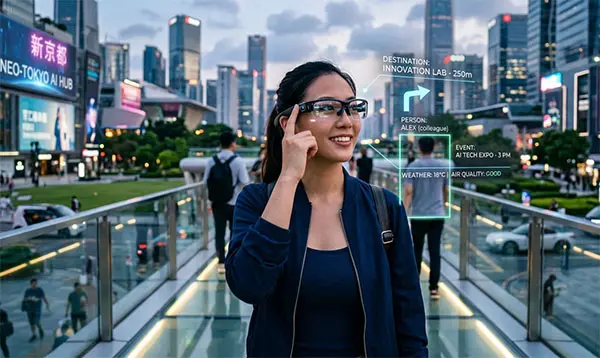
Frequently Asked Questions (FAQ)
FAQ 1 — Are AI glasses only for tech-savvy users?
No. While early adopters were predominantly tech-focused, modern AI glasses are increasingly designed for mainstream users. Products like Ray-Ban Meta prioritize ease of use, with simple voice commands and familiar form factors that require no technical background to operate.
FAQ 2 — What age group is most likely to buy AI glasses?
Currently, the 25–44 age bracket shows the highest adoption rates, driven by a mix of professional utility and comfort with wearable technology. However, AI glasses designed for accessibility and health monitoring are gaining traction among older adults (55+), and Gen Z (18–24) represents a fast-growing future segment.
FAQ 3 — Do AI glasses appeal to women as much as men?
Historically, wearable tech has skewed male. However, as AI glasses improve in design and move toward fashion-forward aesthetics — particularly through brand collaborations — female adoption is accelerating. Brands like Ray-Ban Meta have made explicit efforts to offer frames with broad gender appeal.
FAQ 4 — Are AI glasses useful for people with disabilities?
Absolutely — and this may be one of their most impactful applications. AI glasses with real-time voice narration, object recognition, live captioning, and navigation assistance can provide meaningful independence for users with visual impairments, hearing loss, or cognitive challenges.
FAQ 5 — How do AI glasses compare to smartwatches for professionals?
Smartwatches are great for glanceable data on your wrist. AI glasses are better suited for hands-free, heads-up interactions — ideal when your hands are occupied or when you need richer contextual information without looking away from what you’re doing. Many professionals use both as complementary tools.
FAQ 6 — What are the main barriers stopping more people from buying AI glasses?
The top barriers are price (most quality AI glasses cost $300–$700+), battery life limitations (typically 4–8 hours), social discomfort around embedded cameras, and concerns about data privacy. As these friction points reduce, adoption will expand beyond early adopters.
FAQ 7 — Will AI glasses replace smartphones in the future?
Not entirely — at least not in the near term. AI glasses are better understood as a complement to smartphones: handling ambient, hands-free interactions while the phone remains the primary hub for intensive tasks. Longer term, as AI and battery technology advance, glasses may absorb an increasing share of daily digital interaction.