
How to Choose an AI Glasses Manufacturer: 8 Factors Every B2B Buyer Must Know
Choosing the wrong AI glasses manufacturer can cost you months of delays, wasted prototypes, and a product that fails quality checks at customs. The decision involves more than just comparing prices – it requires evaluating a supplier across 8 critical dimensions that directly affect your product quality, timeline, and long-term business relationship.
How to Choose an AI Glasses Manufacturer ?
This guide breaks down exactly what B2B buyers – whether you are launching a private label brand, procuring corporate devices, or building a custom IoT solution – need to verify before signing any OEM or ODM agreement.
Quick Definition: An AI glasses manufacturer is a factory or engineering company that produces smart eyewear with integrated AI capabilities – such as voice assistants, cameras, audio output, real-time translation, or AR overlays. OEM manufacturers produce hardware to your specifications; ODM manufacturers offer pre-designed models you can rebrand.
Why Manufacturer Selection Is the Most Critical Decision in Your Product Journey
Unlike consumer electronics from established brands, AI glasses sit at the intersection of optics, microelectronics, connectivity, and AI software. A manufacturer weak in any one of these areas will produce a product that disappoints your end users.
The global AI glasses market is projected to grow from $1.2 billion in 2024 to over $8 billion by 2029. Early movers who lock in reliable manufacturing partnerships will capture disproportionate market share. Those who choose partners based on price alone will struggle with inconsistent quality, missed launches, and IP risks.
Factor 1: Technical Capability and Product Range
The first question to ask any manufacturer is simple: what AI glasses types do you actually produce – not just sell or broker?
A capable manufacturer should have proven production experience across multiple product categories. If they only handle audio glasses but you need a camera-equipped model, they are not the right partner regardless of their pricing.
Core AI Glasses Product Categories
| Product Type | Key Components | Typical MOQ |
|---|---|---|
| AI Audio Glasses | Open-ear speakers, mic array, BT 5.3+ | 200-500 units |
| AI Camera Glasses | 1080p+ lens, onboard storage, privacy LED | 300-1000 units |
| AI Translation Glasses | Bone conduction audio, cloud NLP integration | 500-2000 units |
| AI Live Streaming Glasses | 4G/5G module, H.264/H.265 encoding | 500-2000 units |
Ask for physical samples of each product type they claim to manufacture. A legitimate manufacturer will have sample units available within 3-5 business days, not weeks. If you are still deciding which product category fits your market, see our breakdown of AI glasses vs smart glasses vs AR glasses to understand the key technical and use-case differences before approaching any supplier.
Checklist: Technical Capability Questions
- Do they have an in-house R&D team, or do they outsource engineering?
- Can they share a product roadmap for the next 12-18 months?
- Have they shipped AI glasses to customers in the US, EU, or Japan? (These markets have the strictest quality requirements.)
- Can they provide teardown photos or component sourcing details?
Factor 2: Certifications and Regulatory Compliance
This factor alone eliminates most low-quality manufacturers. AI glasses that incorporate cameras, wireless radios, and audio systems must pass multiple regulatory certifications before they can be legally sold in major markets.
Required Certifications by Market
| Market | Required Certifications | Penalty for Non-Compliance |
|---|---|---|
| United States | FCC ID, UL (if rechargeable battery) | Import seizure, fines up to $100K/day |
| European Union | CE Mark, RoHS, WEEE | Market withdrawal, civil liability |
| Japan | PSE (battery), MIC (radio) | Criminal penalties for importers |
| China (domestic) | CCC, SRRC | Sales ban, factory shutdown |
A trustworthy manufacturer will proactively show you certification documents. If they say “we can get it certified after you place an order” – that is a red flag. Certifications should already exist for standard product models.
Pro Tip: Verify FCC IDs independently at fcc.gov/oet/ea/fccid. Any manufacturer claiming FCC compliance should have a searchable FCC ID on their product or packaging.

Factor 3: Minimum Order Quantity and Pricing Flexibility
MOQ is often the first number buyers focus on, but the structure of MOQ matters more than the number itself.
A manufacturer with a 200-unit MOQ but no flexibility on customization options may be less valuable than one with a 500-unit MOQ that allows full hardware and firmware customization.
Understanding MOQ Tiers for AI Glasses
| Order Volume | Typical Unit Price Range | Customization Level |
|---|---|---|
| Sample (1-10 units) | 2x-4x standard price | Limited (existing models only) |
| Small Batch (50-200 units) | Standard +20-40% | Logo, color, basic firmware |
| Standard MOQ (200-1000 units) | Standard price | Full OEM branding |
| Volume (1000+ units) | Standard -10-20% | Full ODM + hardware modifications |
Always negotiate a sample-to-production price bridge. Some manufacturers dramatically increase prices between the sample stage and the production order – this should be disclosed upfront and written into your contract. For a full breakdown of what different AI glasses categories cost at retail and wholesale, see our AI glasses price guide by type – it gives you a useful benchmark when evaluating whether a manufacturer’s unit pricing is competitive.
Factor 4: OEM vs ODM Capability – Know the Difference
Many manufacturers use “OEM” and “ODM” interchangeably, but they represent fundamentally different business models with different risk profiles for buyers.
OEM: You Own the Design
In an OEM arrangement, you provide the engineering specifications and the manufacturer builds to those specs. This gives you full IP ownership of the product design, but requires your own R&D investment and longer development timelines (typically 6-12 months for a new AI glasses model).
ODM: Manufacturer Owns the Design
In an ODM arrangement, the manufacturer has an existing design you license and rebrand. This is faster (2-8 weeks to market), lower cost, but you share the underlying design with other brands that source from the same factory.
Which Is Right for You? If differentiation is your core competitive strategy, push for OEM. If speed to market is the priority and your brand identity comes from software, marketing, or distribution rather than hardware design, ODM is the smarter choice.
Questions to Clarify Before Signing
- Who owns the molds, tooling, and firmware after development?
- Is there an exclusivity option to prevent the same design from being sold to competitors?
- What happens to your inventory if the manufacturer discontinues the base model?
Factor 5: Supply Chain Stability and Component Sourcing
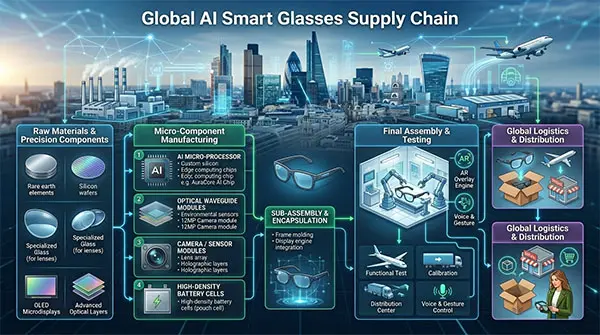
The AI glasses supply chain is complex. A single product may contain chipsets from Qualcomm or MediaTek, optical components from Chinese or Taiwanese suppliers, battery cells from South Korea, and PCB assemblies from multiple Shenzhen-area manufacturers.
Disruptions to any of these components can halt your production. Experienced manufacturers maintain buffer inventory and have qualified backup suppliers for critical components.
Key Supply Chain Questions
- Where do the key chips (SoC, Bluetooth, camera sensor) come from?
- Do they have at least two qualified sources for critical components?
- What was their on-time delivery rate in the past 12 months?
- How did they handle the chip shortage of 2021-2023? What did they learn from it?
The best manufacturers will answer these questions confidently and with specifics. Vague answers like “we have good relationships with suppliers” should raise concerns.
Factor 6: Quality Control Process and Defect Rates
Quality control in AI glasses manufacturing is multi-layered. It covers not just physical assembly but also electronic performance, software stability, waterproofing, and battery safety.
What a Robust QC Process Looks Like
| QC Stage | What Is Checked | Pass/Fail Criteria |
|---|---|---|
| Incoming Component Inspection | Chip specs, lens clarity, battery capacity | 100% match to approved specs |
| In-Process Assembly Check | Solder quality, cable routing, housing fit | Zero tolerance for short circuits |
| Functional Testing | Audio output, camera resolution, BT pairing | 100% pass before boxing |
| Final OQC | Cosmetic defects, packaging, accessories | AQL 1.0 or better |
Request the manufacturer’s current defect rate (ideally below 1% for mature products) and ask whether they allow third-party inspections. Refusing third-party audits is a major red flag.
Factor 7: Customization Depth – Hardware, Software, and Branding
What can you actually customize? This varies enormously between manufacturers. Some only offer logo printing on an existing product. Others can modify the chipset, redesign the frame geometry, rewrite firmware, and integrate your proprietary cloud API.
Customization Levels to Request
- Level 1 – Branding only: Logo, color, packaging (2-4 weeks)
- Level 2 – Software customization: Custom UI, wake word, cloud API integration (4-8 weeks)
- Level 3 – Hardware modification: Frame design, component swap, new sensor integration (3-6 months)
- Level 4 – Full ODM development: New product from scratch to mass production (6-18 months)
Be specific about which level you need from the start of negotiations. Many buyers lose months because they assumed Level 3 was included in a quote that only covered Level 1.
Factor 8: Communication, Lead Times, and After-Sales Support
The manufacturer you choose will become a long-term business partner. Poor communication is not just annoying – it costs money through misunderstood specifications, delayed prototypes, and unresolved warranty claims.
Communication Red Flags
- Responses take more than 24 hours during business hours
- No dedicated account manager for your project
- Engineering questions are answered by sales staff who cannot give technical details
- No written confirmation of verbal agreements
Lead Time Benchmarks
| Milestone | Reasonable Timeline | Warning Sign |
|---|---|---|
| Sample delivery (existing model) | 5-10 business days | More than 3 weeks |
| First prototype (new design) | 30-60 days | More than 90 days |
| Mass production lead time | 30-45 days after approval | More than 60 days for standard orders |
| Warranty claim response | Within 48 hours | No SLA defined in contract |
Always ask for references from existing customers in a similar market (e.g., a US buyer, a European brand). A manufacturer with nothing to hide will connect you within a week.
How to Evaluate Manufacturers: A Scoring Framework
Rather than making a gut-feel decision, score each manufacturer candidate across the 8 factors on a 1-5 scale. Weight the factors according to your specific priorities.
| Factor | Weight | Score (1-5) |
|---|---|---|
| Technical Capability | 20% | |
| Certifications | 20% | |
| MOQ and Pricing | 10% | |
| OEM/ODM Capability | 15% | |
| Supply Chain Stability | 10% | |
| Quality Control | 10% | |
| Customization Depth | 10% | |
| Communication and Support | 5% |
Any manufacturer scoring below 3.0 on Certifications or Quality Control should be disqualified regardless of their total score. These are non-negotiable factors where shortcuts create legal and reputational risk.
Conclusion: The Right Manufacturer Is a Competitive Advantage
The AI glasses market is growing fast, but so is the number of contract manufacturers claiming expertise they do not have. By systematically evaluating suppliers across these 8 factors – technical capability, certifications, pricing, OEM/ODM depth, supply chain resilience, QC rigor, customization range, and communication quality – you dramatically reduce the risk of a failed product launch.
The best manufacturers are not always the cheapest, but they are the ones that make your product better, get it to market faster, and stand behind it when problems arise. Once you have identified the right manufacturing partner, the next step is understanding the full landscape of AI glasses product types so you can align your product roadmap with the categories that have the strongest market demand.

Frequently Asked Questions
What is the minimum order quantity for AI glasses OEM manufacturing?
Most AI glasses manufacturers require a minimum order quantity (MOQ) of 200 to 500 units for standard OEM branding, and 1,000 units or more for custom hardware modifications. Sample orders (1-10 units) are typically available at 2x to 4x the standard unit price to cover tooling and setup costs.
How long does it take to develop a custom AI glasses product from scratch?
A full ODM development cycle – from concept to mass production – typically takes 6 to 18 months depending on the complexity of hardware modifications, firmware customization, and certification requirements. Simpler projects using an existing base model with firmware changes can be completed in 2 to 3 months.
What certifications should AI glasses have before being sold in the US?
AI glasses sold in the United States must carry FCC certification for their wireless radio components (Bluetooth, Wi-Fi, or cellular). Products with lithium batteries may also require UL certification. Cameras integrated into eyewear are subject to additional privacy-related regulations in several US states.
What is the difference between OEM and ODM for AI glasses?
OEM (Original Equipment Manufacturer) means you provide the design specifications and the manufacturer builds to your blueprint – you own the IP. ODM (Original Design Manufacturer) means you license and rebrand an existing design that the manufacturer owns. OEM offers greater differentiation; ODM offers faster time-to-market and lower development cost.
How do I verify that an AI glasses manufacturer is legitimate?
Request FCC or CE certification documents and verify them independently (FCC IDs are searchable at fcc.gov). Ask for a factory audit or third-party inspection. Request customer references in your target market. A legitimate manufacturer will welcome verification; a fraudulent one will delay, deflect, or refuse.
What quality control standards should AI glasses manufacturers meet?
Reputable AI glasses manufacturers should comply with ISO 9001 for quality management systems and apply AQL (Acceptable Quality Level) sampling standards of 1.0 or better for finished goods. They should conduct 100% functional testing of electronic components before shipment and maintain a documented defect rate below 2% for mature product lines.
Can I get exclusive manufacturing rights so competitors cannot use the same design?
Yes, but exclusivity typically requires a higher MOQ commitment or a one-time exclusivity fee ranging from $5,000 to $50,000 depending on the manufacturer and product complexity. Without an explicit exclusivity clause in your contract, the manufacturer can – and often will – sell the same base design to your competitors under their branding.