
How Do AI Glasses Work? The Complete Technology Breakdown (2026)
AI glasses are no longer a futuristic concept. They are on sale today, worn by consumers, field workers, and content creators around the world. But most people who ask “how do AI glasses work?” get a vague answer about cameras and chips. This article gives you the complete technical picture – every layer of the hardware, every software process, and every design decision that makes modern AI glasses function.
What Makes AI Glasses Different from Regular Smart Glasses
The term “smart glasses” has been around since the early 2010s. Google Glass, Snapchat Spectacles, and basic Bluetooth audio frames all qualify as smart glasses. What separates AI glasses from that earlier generation is the addition of on-device or cloud-connected artificial intelligence that can understand, reason about, and respond to the world in real time.
Regular smart glasses do one or two fixed things: play audio, capture video, or display notifications. AI glasses do something fundamentally different – they process context. They can recognize faces, translate spoken language, describe what the camera sees, transcribe a meeting, or answer a question about an object in your field of view. The intelligence layer is what makes the difference.
| Feature | Basic Smart Glasses | AI Glasses |
|---|---|---|
| Audio playback | Yes | Yes |
| Camera capture | Sometimes | Yes (usually) |
| On-device AI processing | No | Yes or cloud hybrid |
| Real-time translation | No | Yes |
| Contextual awareness | No | Yes |
| Voice assistant integration | Basic (Siri/Google) | Advanced LLM-based |
The Hardware Stack: What Is Actually Inside AI Glasses
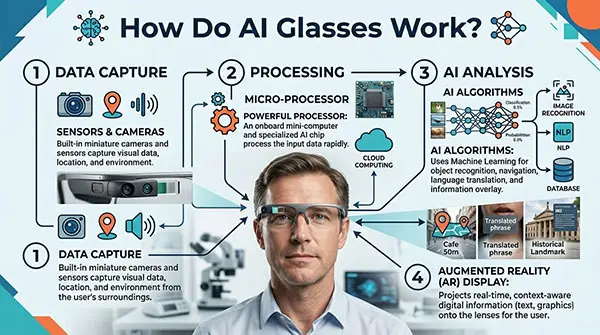
Understanding how AI glasses work starts with the physical components. These devices pack an impressive amount of hardware into a form factor that weighs between 30 and 80 grams. Here is every major component and what it does.
1. The Processor (SoC)
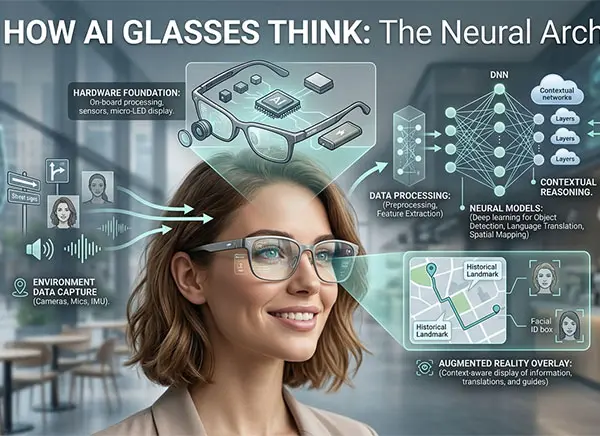
The brain of any AI glasses product is the system-on-chip (SoC). This single integrated circuit combines the CPU, GPU, image signal processor (ISP), and often a dedicated neural processing unit (NPU) or AI accelerator. The NPU is what allows on-device AI inference without sending every task to the cloud.
Common chipsets used in AI glasses include Qualcomm’s Snapdragon AR series, MediaTek chips with APU (AI Processing Unit) cores, and proprietary chips developed by larger players. The NPU in these chips can handle tasks like wake-word detection, image classification, and speech-to-text entirely on the device, which reduces latency and protects user privacy.
2. The Camera Module
Most AI glasses include at least one front-facing camera, typically mounted on the bridge or one of the temples. Camera resolution ranges from 8MP in entry-level devices to 32MP or higher in premium models. The camera serves as the primary sensory input for AI functions – it is how the glasses “see” the world.
In translation glasses, the camera reads text in the environment. In camera glasses designed for content creation, it captures POV video. In enterprise AR glasses, the camera feeds into computer vision algorithms that identify objects, people, or equipment in the field.
3. Microphones and Speakers
AI glasses almost universally include dual or quad microphones for beamforming – a technique that isolates the user’s voice from background noise. This is critical for voice commands and real-time translation, where accuracy depends on clean audio input.
Speakers are typically open-ear directional transducers mounted near the ears on the temples. This design allows users to hear AI audio output without blocking ambient sound – an important safety feature and a key differentiator from earbuds.
4. Connectivity Modules
AI glasses connect to the world through a combination of Bluetooth 5.x, Wi-Fi (usually 802.11ac or Wi-Fi 6), and sometimes 4G LTE modems. Bluetooth handles the pairing with a smartphone, which acts as the primary relay for cloud AI services. Wi-Fi is used for direct cloud connections and OTA (over-the-air) firmware updates.
5. The Battery
Battery capacity is one of the most constrained aspects of AI glasses design. With a target weight under 50 grams for most consumer devices, engineers typically have room for a 150-500mAh battery in each temple. This translates to 3-8 hours of continuous use depending on workload. Camera-heavy tasks drain the battery significantly faster than audio-only use.
6. Sensors
Beyond camera and microphone, AI glasses include a range of secondary sensors. An accelerometer and gyroscope track head movement and orientation. Some models include ambient light sensors that adjust display brightness, proximity sensors that detect when the glasses are worn, and even eye-tracking sensors in high-end AR variants.
| Component | Function | Key Spec to Look For |
|---|---|---|
| SoC / NPU | On-device AI inference | NPU TOPS rating |
| Camera | Visual input for AI processing | Resolution, FOV, stabilization |
| Microphones | Voice input, translation, commands | Beamforming, noise cancellation |
| Speakers | Audio output without isolation | Open-ear directional design |
| Battery | Power supply | mAh, charging case capacity |
| Connectivity | Cloud AI relay, smartphone sync | Bluetooth 5.x, Wi-Fi 6 |

The Software Stack: How AI Glasses Think
Hardware is only half the story. The software architecture determines what AI glasses can actually do and how fast they can do it. There are three layers: the on-device OS and firmware, the companion app, and the cloud AI services.
On-Device Firmware and OS
Most AI glasses run a lightweight real-time operating system (RTOS) or a stripped-down version of Android. The firmware manages hardware resources, handles sensor inputs, runs wake-word detection models locally, and coordinates communication between components. The NPU runs small, quantized AI models directly on the chip – these models are compressed versions of larger neural networks optimized to run on limited hardware.
The Companion App
The smartphone companion app is the control center for most AI glasses. It handles user authentication, settings configuration, firmware updates, and acts as the relay between the glasses and cloud AI services. When you speak a command to your AI glasses, the audio often travels via Bluetooth to the phone, gets processed by the cloud, and the result comes back through the phone to the glasses’ speaker – all in under 2 seconds on a good connection.
Cloud AI Services
The cloud layer is where the heavy AI lifting happens. Large language models (LLMs) like those powering ChatGPT or Google Gemini handle complex natural language understanding and generation. Neural machine translation models handle real-time language conversion. Computer vision APIs handle image recognition and scene description. These cloud services are what give AI glasses their “intelligence” – the on-device NPU handles speed-sensitive lightweight tasks, while the cloud handles tasks that require large models.

How Specific AI Functions Actually Work
With the hardware and software foundation in place, here is how the most common AI glasses functions operate step by step.
Real-Time Translation
Translation in AI glasses works through an audio pipeline. The microphones capture incoming speech. Beamforming isolates the target voice. The audio is sent (via Bluetooth through the phone) to a cloud-based speech-to-text engine, which converts the audio to text. That text is passed to a neural machine translation model, which outputs the translated text. A text-to-speech engine converts it back to audio, and the translated speech plays through the open-ear speakers – typically within 1-3 seconds of the original utterance.
For text translation (reading signs, menus, or documents), the camera captures an image, an OCR model extracts the text, a translation model converts it, and the result is either displayed on a small screen or read aloud. If you want to see how this performs across specific product models, see our comparison of AI glasses vs smart glasses vs AR glasses.
Voice Assistant Integration
Wake-word detection runs entirely on-device using a small neural network model (typically under 1MB). When the model detects the trigger phrase, it activates the microphone array and starts streaming audio to the cloud. The cloud LLM processes the query and returns a response. The entire pipeline is designed to minimize latency – wake-word response under 200ms, full LLM response under 2 seconds in optimal network conditions.
POV Video Recording
For content creation use cases, the camera captures video at 1080p or 4K, compresses it using H.264 or H.265 codec in real time, and stores it either in onboard flash memory or streams it directly to a cloud platform. AI processing can add real-time stabilization, auto-exposure, and in some models, AI-generated captions or scene tags.
AR Display Overlay
AI glasses with display capability use either micro-LED projectors, OLED microdisplays, or waveguide optics to overlay information on the user’s field of view. Waveguide displays use diffractive optics to guide light from a projector into the user’s eye while maintaining optical transparency. The result is a see-through display where digital content appears to float in the real world. This is the most complex and expensive display technology in the market today.
On-Device vs Cloud Processing: The Key Trade-Off
Every AI glasses manufacturer faces a fundamental engineering decision: how much processing to do on the device versus in the cloud. There is no single right answer – it depends on the use case, target price, and network assumptions.
| Processing Type | Advantages | Disadvantages |
|---|---|---|
| On-device only | Works offline, low latency, privacy-first | Limited AI capability, higher chip cost |
| Cloud only | Powerful AI, easier to update models | Requires internet, higher latency, privacy concerns |
| Hybrid (most common) | Balanced performance and capability | Complexity, depends on phone relay |
Most consumer AI glasses use the hybrid model. Latency-sensitive tasks (wake words, basic gesture detection) run on-device. Intelligence-heavy tasks (LLM queries, translation, image understanding) go to the cloud. Enterprise AI glasses used in environments without reliable internet connectivity tend to favor on-device processing, which requires more powerful (and more expensive) chips.
How Display Technology Works in AI Glasses
Not all AI glasses have displays. Audio-only AI glasses (like AI audio glasses) have no visual output beyond an optional LED indicator. Camera-based AI glasses may have a small notification LED or a tiny status display. Full AR AI glasses include a proper display system – and this is where the technology gets complex.
Waveguide Optics
Waveguide displays are the gold standard for AR glasses. A compact projector (usually based on LCOS, DLP, or laser scanning technology) generates the image. The waveguide – a thin slab of optical glass – uses microscopic diffractive gratings to capture the light, guide it across the lens, and then redirect it toward the eye. The result is a transparent lens with a digital image overlaid on the real-world view. This technology is why premium AR glasses cost $300-$3,500 or more – waveguide manufacturing is precision optics work.
Birdbath and Prism Displays
Lower-cost AI glasses with displays often use birdbath optics (a curved half-mirror that reflects a display into the eye) or simple prism designs. These are cheaper to manufacture but result in bulkier frames and less optical transparency. They are common in enterprise-grade AR headsets and some mid-range consumer devices.
How AI Glasses Are Manufactured: OEM and ODM Explained
Most AI glasses brands do not build their own hardware from scratch. The global supply chain for AI glasses is centered primarily in Shenzhen, China, where a network of specialized manufacturers handle different components of the production process.
An OEM (Original Equipment Manufacturer) produces glasses to a brand’s exact specifications – the brand designs everything, the factory builds it. An ODM (Original Design Manufacturer) offers existing hardware designs that brands can customize with their branding, software, and packaging. ODM is the faster and lower-risk path for new market entrants.
For a full breakdown of the sourcing and supplier evaluation process, see our guide on how to choose an AI glasses manufacturer. And if you are evaluating the cost implications of building your own AI glasses product, the AI glasses price guide by type covers the full range of retail and wholesale pricing.
What Limits AI Glasses Today
AI glasses technology has advanced rapidly, but several constraints still define what current-generation devices can and cannot do well.
Battery life remains the most common user complaint. Most devices last 3-6 hours of active use. The combination of always-on microphones, active radios, and AI inference is power-hungry, and the small form factor limits battery capacity. Charging cases (similar to true wireless earbuds) extend total daily usage but add bulk and cost.
Latency affects translation and voice assistant quality. Cloud round-trip time depends on the user’s internet connection. In areas with poor LTE or Wi-Fi coverage, translation delay can exceed 4-5 seconds – noticeable enough to disrupt conversation flow.
Display resolution and field of view are limited in current AR glasses. Even high-end waveguide displays offer a field of view of 30-50 degrees – much narrower than human vision (approximately 210 degrees). The “magic window” effect means AR content only fills a small portion of what the user sees.
Frame weight and comfort are ongoing challenges. Adding displays, batteries, and processors to a frame that needs to sit on a nose bridge for hours is a genuine engineering problem. Weight distribution, pressure points, and heat dissipation all affect wearability.
The Future Direction of AI Glasses Technology
The trajectory of AI glasses development points toward several clear improvements over the next 2-3 years. On-device AI capability will increase as chip manufacturers release more efficient NPU designs – this will bring more functions offline and reduce cloud dependency. Display technology will improve as waveguide manufacturing scales up and costs come down. Battery technology advancements (solid-state batteries, more efficient power management) will extend usage time.
Perhaps most significantly, the software layer will mature. As LLMs become smaller and more efficient, running a capable language model entirely on-device becomes feasible. This would allow AI glasses to function as a true always-on AI assistant without requiring a phone connection – a major shift in the product category.

Frequently Asked Questions
Do AI glasses need to be connected to a phone to work?
Most current AI glasses require a smartphone connection via Bluetooth to relay audio and data to cloud AI services. Basic functions like audio playback and camera recording typically work offline, but advanced features like real-time translation, voice assistant queries, and image understanding require a cloud connection through the paired phone.
How accurate is real-time translation in AI glasses?
Modern AI glasses using cloud-based neural machine translation can achieve 85-95% accuracy for major language pairs (English, Chinese, Spanish, French, German, Japanese) in clear audio conditions. Accuracy drops in noisy environments, with heavy accents, or for low-resource language pairs. Translation delay is typically 1-3 seconds under good network conditions.
What is the difference between AI glasses and AR glasses?
AR (Augmented Reality) glasses specifically add a visual display that overlays digital content on the real world. AI glasses is a broader category – some have AR displays, but many do not. AI glasses primarily refers to glasses with an AI processing capability (translation, voice assistant, image understanding), regardless of whether they have a visual display. All AR glasses with AI features are AI glasses, but not all AI glasses are AR glasses.
Can AI glasses work in noisy environments?
Yes, to a degree. Most AI glasses use dual or quad microphone arrays with beamforming algorithms that focus on the user’s voice direction and suppress ambient noise. This works well in moderately noisy environments. In very loud environments (concerts, factories, busy streets), accuracy of voice commands and translation degrades. Some enterprise models add active noise processing specifically for industrial use cases.
How long do AI glasses batteries last?
Battery life varies significantly by product type and use case. Audio-only AI glasses with minimal AI processing typically last 5-8 hours. Camera glasses with active recording last 1.5-3 hours. Full AR display glasses with continuous use last 2-4 hours. Most products include a charging case that provides 1-3 additional charge cycles. For a full comparison, see our breakdown of AI glasses battery performance by category.
Is the data from AI glasses cameras and microphones private?
Privacy practices vary by manufacturer. Most AI glasses process wake-word detection on-device without sending data to the cloud continuously. However, once activated, audio and camera data is typically transmitted to cloud AI services for processing. Review the manufacturer’s privacy policy carefully – look for details on data retention, third-party sharing, and whether local-only processing modes are available. Enterprise buyers should request a Data Processing Agreement (DPA).
What chipset powers most AI glasses?
The majority of consumer and commercial AI glasses use chips from Qualcomm (Snapdragon AR series), MediaTek (MT series with APU), or Rockchip. High-end enterprise AR glasses sometimes use custom silicon. The NPU (Neural Processing Unit) within these chips is the component most responsible for on-device AI inference capability – look for chips with at least 4 TOPS (Tera Operations Per Second) for meaningful on-device AI performance.